
.png)

Coaches and analysts don’t think about space in terms of static zones. They think in terms of where the opponent lines of pressure are and what space is available around their block.
Is the ball being played into the block or outside it?
Is the long ball dropping between their midfield and back line, or somewhere harmless?
Is the switch landing beyond their pressure, or still inside it?
Those are the questions that actually shape decisions on the pitch.
What's new?
MyGamePlan already gave clubs a way to work with this through horizontal relative zones – zones defined relative to the opponent’s lines of pressure (first line, second line, last line).
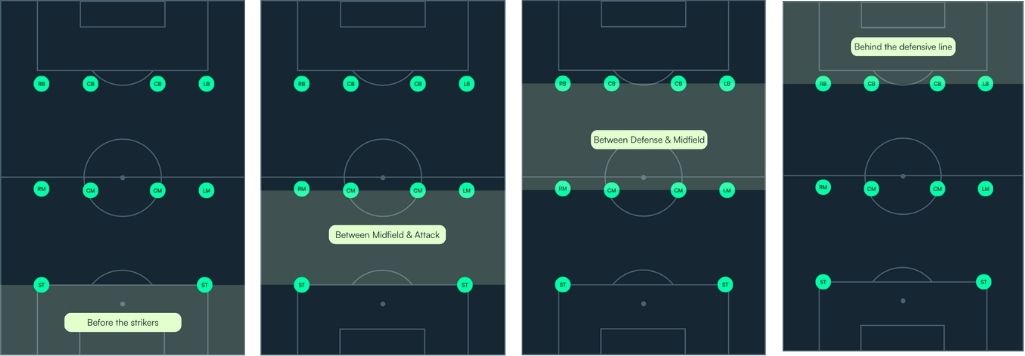
With this release, we’re adding the missing dimension: Vertical relative zones, defined relative to the width and shape of the opponent’s block.
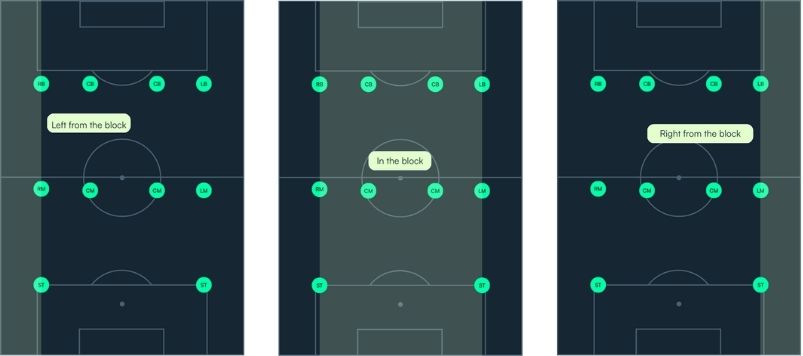
Together, they will make your analysis more contextual, opponent-aware, and intentional - which will allow you to get better insights.
How we define relative zones
We calculate this using tracking data to:
- Capture the position of every player on the pitch
- Identify where and how the defending team’s is structured:
- the lines of pressure (horizontal dimension)
- the centre and width of the block (vertical dimension)
From that, we can define zones such as:
- Inside the block: between specific lines (e.g. between midfield and defence)
- Outside the block: just beyond its width on left or right
- In front of / behind specific lines: using the same logic as horizontal relative zones (before the strikers, behind the defensive line etc.)
The crucial part is that these zones move dynamically with the opponent’s organisation. “Centre of the block” or “outside the block on the far side” always means exactly that, regardless of the formation and position of players on paper.
How this helps your workflow
Our goal is to help you get to better insights faster, and this update will improve both the quality and efficiency of your analysis. You can now measure behaviors in the precise spaces that matter for your game model, and you stop wasting time on clips that were never relevant in the first place.
An example of this is second-ball analysis on long passes. Lets say you want to know how good your team is at winning second balls. In the past you would create a custom tracker to filter all long passes into the final third and check the data and video - but you would see many actions where the ball lands in areas where there’s no real contest, or don’t match the game situations you care about.
Now you can set a end location for the long pass as "zone between the defence and midfield" and "inside the block" and immediately see situations that are actually relevant to your question.
You can use relative zones to connect your principles of play directly to space around the opponent block, for example:
- Escaping pressure: Measure how often your switches actually reach zones outside the block on the opposite side.
- Attacking key pockets: Analyse receptions and combinations in pockets just in front of the back line, in the centre of the block, or outside it.
Vertical relative zones are now available in MyGamePlan and can be combined with horizontal relative zones on your existing trackers.
If you want to see how this can sharpen things like second-ball analysis, switches of play or attacking pockets around the opponent block, let us know and we’ll walk through a few examples on your own games.
We can build this around the way your team plays. Book a call.
.jpg)