Blog·
How the analyst role changes with automation

MyGamePlan
Football Analytics Platform
For a long time, the working week of many analysts has been shaped by production.
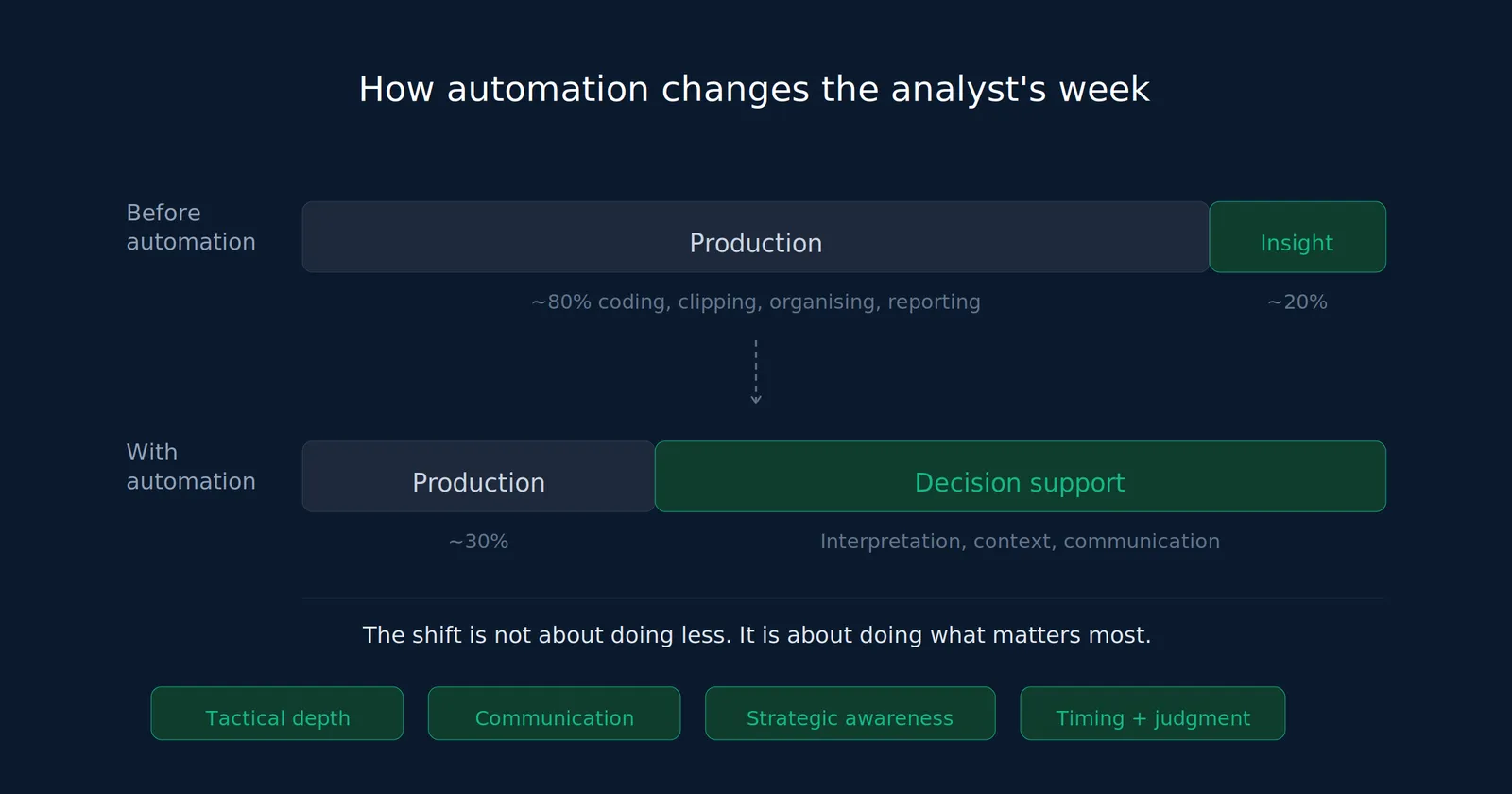
Matches need coding. Clips need exporting. Footage needs organising. Reports need rebuilding. Even in strong environments, a large part of the role has involved turning raw material into something the staff can use in time for the next conversation.
That work matters. It requires focus, consistency, and a strong eye for detail. But it also takes up a huge amount of time, and time is usually the scarcest resource inside a performance environment.
As automation starts to reduce some of that load, the role begins to shift. Not all at once, and not in the same way at every club, but enough to change what the job is built around.
The question is no longer just how quickly an analyst can produce material. It is increasingly about what they do once more of that material can be produced automatically.
The operational layer changes first
A large portion of analysis work has historically been operational: coding matches manually, tagging events frame by frame, exporting clips, organising footage, aggregating data, building repetitive reports.
These tasks are essential. They are part of the reason analysis can function inside a weekly cycle. But they are also highly repeatable, which makes them the first part of the role most likely to be reduced by automation.
For years, analysts have had to spend so much time preparing information that the deeper part of the work, interpretation, framing, timing, and decision support, had less space than it deserved. Not because it was less important, but because the mechanical layer demanded so much attention.
As that pressure eases, the role becomes less about producing information and more about shaping what that information means.
From operator to decision support
In many clubs, analysts have historically been positioned as operators. Their value was visible in the speed and quality of the output: how quickly the match was coded, how reliable the tagging was, how well the clips were prepared.
Those skills still matter. But they are no longer enough to define the role on their own.
As automation takes care of more of the repeatable layer, the analyst's value moves closer to the coaching process itself. The role becomes more about helping staff see the right patterns, focus on the right problems, and act on the right information.
In practice, that can mean:
- Identifying patterns in the context of the club's game model
- Connecting data and video to the tactical identity
- Shaping the information flow for coaches and players
- Challenging assumptions when the evidence points elsewhere
- Protecting clarity when pressure and time constraints are high
The analyst is no longer only preparing material for others to interpret. They are helping structure the logic of the discussion itself.
That is a different level of contribution. And it puts more attention on the human side of the role.
When production is the main bottleneck, value is measured in effort and output. When production becomes less demanding, value is judged by clarity, context, and influence. Can the analyst explain why a pattern is happening, not just point out that it exists? Can they connect what they see on video to the game model the club believes in? Can they help staff understand which details are worth acting on, and which are simply interesting?
That will be uncomfortable in some environments and empowering in others.
The skills that start to matter more
Technical proficiency still matters. Analysts still need to work well with tools, data, and video. But those things become less distinctive over time, especially as access to similar technology spreads across the game.
What starts to separate analysts more clearly is their ability to make football sense of what the tools produce.
Tactical depth. Understanding not just what happened, but why it happened and what it means within a specific playing model.
Communication. Turning complex patterns into language that coaches and players can actually use.
Strategic awareness. Knowing which information matters for this game, this coach, and this moment in the week.
Timing. A good insight delivered at the wrong moment can still fail to change anything. Analysts who understand when to push, when to simplify, and when to leave something out entirely will become more valuable.
The common thread is judgment. And judgment is much harder to automate than production.
This also changes what clubs should look for
If the role is changing, the hiring logic around the role needs to change too.
Clubs that continue to define analysts mainly through software operation will end up limiting the role, even if they invest in better tools. They may increase output, but they will not necessarily improve decision-making.
Clubs that benefit most from automation will be the ones that position analysts closer to the coaching cycle: not just around coding and reporting, but around review, preparation, communication, and performance support.
That requires a different kind of trust. It means giving analysts enough ownership to do more than assemble material. It means expecting them to contribute to how the club understands performance, not just how it displays it. And it means creating an environment where the analyst's role can evolve beyond being the person who "does the clips."
Without that shift, automation risks making the job narrower rather than stronger. With it, the role becomes more important.
Closing thought
Automation will not remove the need for analysts. It will change where their value is most visible.
The analysts who thrive will not just be the ones who can operate systems efficiently. They will be the ones who can turn information into clarity at the right moment, in the right language, for the right decision.
Run this on your own matches.
Ask MGPT about your team or your next opponent. Free to try with your professional email.