By
MyGamePlan

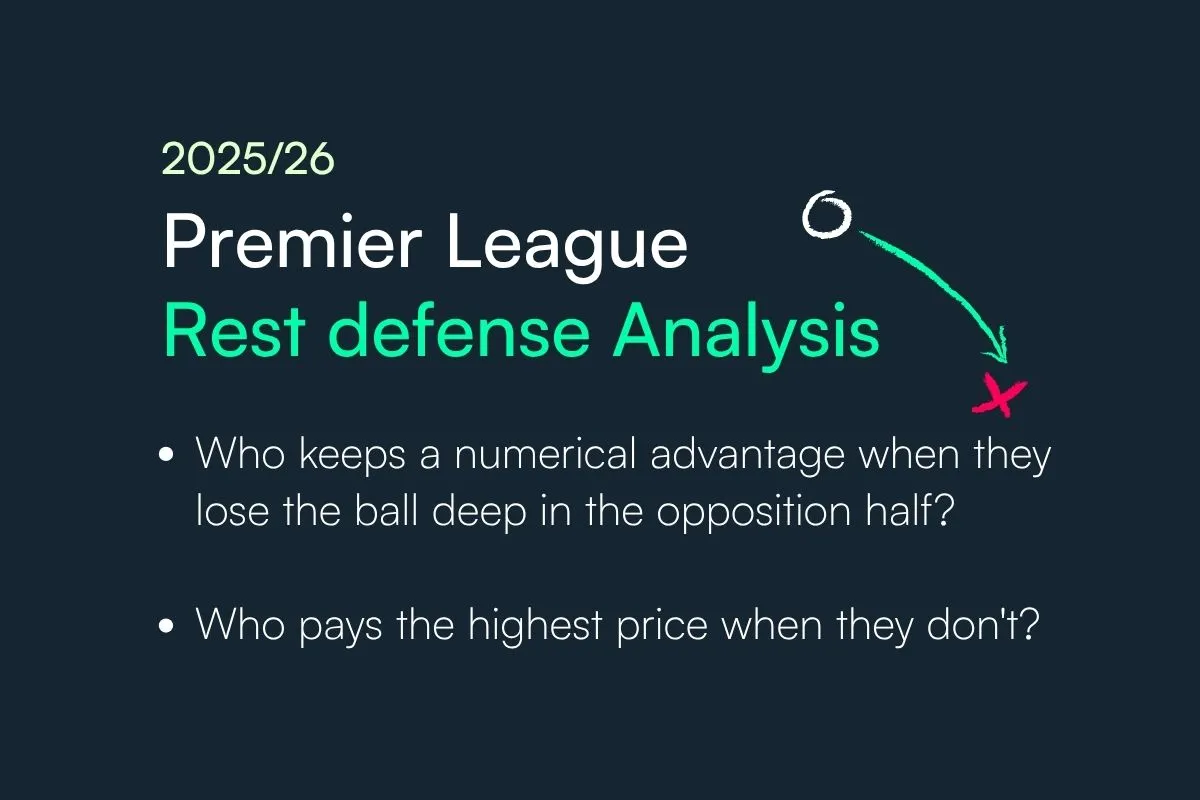
Measuring Rest Defense in the Premier League

June 5, 2026
Min Read
Blog

For decades, transition defending has been one of the most discussed and least measured concepts in football. Coaches build entire identities around it. Pundits invoke it after every counter-attack goal. But the public metrics around rest defense have remained shallow, because rest defense lives in a place that event data and tracking data, used separately, cannot reach.

Event data records what happened on the ball. It tells you when a turnover occurred, who intercepted, where the next pass went. It cannot tell you the positional state of either team at the moment of the turnover.

Tracking data records where every player was, frame by frame. It captures the structure. It cannot tell you which frames matter.

Rest defense is the question of what your shape looks like at the precise second you lose the ball. Answering it at scale requires both data types, synced to the same frame, across thousands of moments. We did that for the 2025/26 Premier League season, and the results separate the league into stories that the league table does not.

What rest defense measures

Rest defense is the shape a team keeps behind the ball while in possession. It only becomes consequential at one moment: the transition to defence.

In that moment, two numbers determine whether the team is structurally safe. The number of defenders in the last line. The number of opponents in their first attacking line. If defenders ≥ attackers + 1, the team has cover. If not, they are outnumbered the instant they lose possession.

Coaches have always known this. The vocabulary predates the data. Coaches talk about leaving a plus-one, covering the press, staggering behind the line. What was missing was the ability to evaluate it across a full league season without a video analyst watching every turnover by hand.

The method

We analysed every Premier League match in 2025/26 with both event and tracking data available. 360 matches.

From those matches, we isolated real counter starts: moments where an opponent intercepted in our first third and followed the interception with a completed pass. That second condition matters. A loose touch that runs out for a throw-in is not a counter start. A scuffed interception that the keeper collects is not a counter start. A real counter start is when the opposition wins the ball deep, controls it, and now has time and space to attack.

1,331 of those across the season.

For each one, we read the tracking frame at the moment of the interception. Two values per frame: defenders in the last line, opponents in the first attacking line. From there, two separate measurements:

  • Structural rest defense. The percentage of a team's conceded counter starts where they had at least one more player in the counter zone than the opposition. A snapshot metric.
  • Shot conversion against. The percentage of those same counter starts that became a shot within 15 seconds. An outcome metric.

The two are related but, as the data shows, not interchangeable.

Structural rankings

Everton lead the league at 92.2%, meaning that in more than nine out of ten counter starts they conceded, they had a numerical advantage behind the ball at the moment of the turnover. Brentford (89.9%), Crystal Palace (89.8%), Manchester City (89.8%) and Burnley (89.7%) round out the top five. Three very different out-of-possession identities produce the same structural outcome: Everton's mid-block, City's positional dominance, Burnley's compact 4-4-2.

At the bottom of the structural rankings: Tottenham (75.7%), Wolves (77.0%), Brighton (80.2%). The only three Premier League sides below 84%.

These are also the three teams whose in-possession structures push the most numbers forward. Spurs commit fullbacks and a midfielder beyond the halfway line in build-up. Brighton's high line and aggressive support runs leave fewer bodies behind the ball. Wolves' attempts to play through pressure stretch the team vertically. The structural exposure is a feature of the system.

So far, intuitive. The teams that commit most to attack are most exposed in transition. The data confirms what the eye sees.

Outcome rankings

Brentford concede a shot on 1.7% of the counter starts they face, roughly one in sixty. Nottingham Forest (2.6%), Bournemouth (2.8%), Chelsea (2.9%) and Everton (3.0%) follow. The league average sits around 5%.

At the bottom: Wolves (12.5%), Newcastle (12.0%), Manchester City (9.3%), Liverpool (8.1%), Arsenal (6.9%). One in eight counter starts becomes a shot against Wolves or Newcastle.

Placed alongside the structural rankings, four teams produce contradictions:

TeamStructural rest defenseShot conversion againstTottenham75.7% (20th)~5% (top half)Brighton80.2% (18th)~5% (top half)Newcastle89.1% (7th)12.0% (19th)Manchester City89.8% (4th)9.3% (18th)

Spurs and Brighton are structurally exposed and outcome-safe. Newcastle and City are structurally covered and outcome-punished. The snapshot does not predict the result.

Three observations

Pressing intensity absorbs structural risk. Tottenham and Brighton commit numbers forward and lose the structural balance most often. The same pressing intensity that creates that exposure also closes the counter in its first seconds. Counter-press is not a separate concept from rest defense. It is the second variable that determines whether structural exposure becomes a shot.

Recovery actions matter more than the snapshot. The moment of turnover sets the initial condition. What happens in the next five seconds determines the outcome: pressure on the ball, the angle of the nearest midfielder's recovery run, the position of the centre-backs relative to the pass lanes. Newcastle's structural cover is good. Their recovery is not. Brighton's structural cover is poor. Their recovery is among the league's best.

Opponent quality is the hidden variable for top teams. Manchester City, Liverpool, Arsenal and Manchester United sit mid-pack structurally and in the bottom five on shot conversion against. The simplest explanation is the quality of opposition they face on the counter. Structural cover that is sufficient against a Burnley counter is not sufficient against a counter taken by a Bukayo Saka or a Mohamed Salah at the other end of the pitch.

What's next

Rest defense is one of several questions that only open up when event data and tracking data are queried together, at the frame level, across a full season.

The structure is now built: synced event and tracking data, the filter for real counter starts, the line detection from the tracking frame. The same approach extends to a series of related questions:

  • What distance do recovering midfielders cover in the five seconds after a turnover, and how does it correlate with shot prevention?
  • Does a team's rest defense degrade in the final fifteen minutes, and for which players specifically?
  • Which build-up patterns produce the worst rest defense outcomes, controlling for opposition press structure?

These are the questions that practitioners ask in meetings every week. The data to answer them has existed for years. The combination of data types, queryable in a few clicks across a league season, is what's new.

Share this post

Analyze more games in less time

Automate tagging
Young man working on laptop editing soccer game footage with graphics showing time spent on tasks in current workflow versus with MyGamePlan.