
.png)

Earlier this month, The Athletic published a piece on the most effective attacking run at this summer's World Cup, built on FIFA's tracking data. The finding: the single most productive movement in the modern game is a run into the channel between the opponent's widest defender and the centre-back nearest to him, arriving in behind the defensive line just as the ball is played.
It is the run that pulls a back line apart. The full-back has to decide whether to follow it inside or hold his width. The centre-back has to decide whether to step across or drop. Either way a gap opens, and the space behind the last line is the space defenders least want to give up.
It stuck with us, so we rebuilt the idea on our own data and ran it across the entire 2025/26 Premier League season, using SkillCorner tracking to place every run against the exact position of the opponent's back line at the moment it was made.
Who makes the most of them
Across the season we found 5,490 of these runs, roughly 14 a game. Below are the eight players who made the most, with every one of their runs plotted. Mint means the runner received the ball and it led to a chance, gold means the run created a chance for a teammate, and grey means it came to nothing.
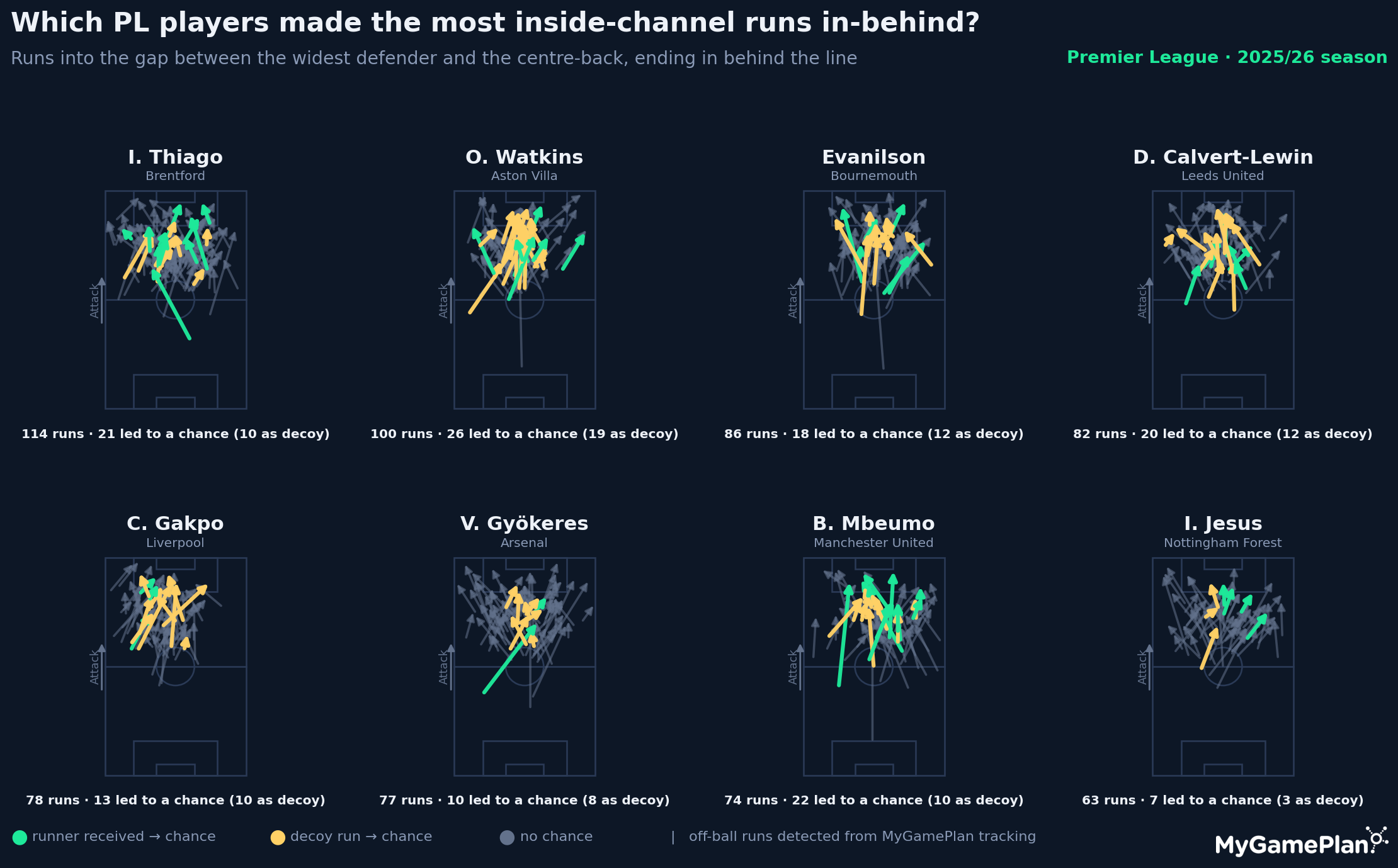
Brentford's Igor Thiago tops the list with 114, ahead of Ollie Watkins (100) and Bournemouth's Evanilson (86), with Dominic Calvert-Lewin, Cody Gakpo, Viktor Gyökeres, Bryan Mbeumo and Igor Jesus close behind. It is a list of genuine runners and penalty-box strikers, which is a good sign the method is finding the right thing.
The run that matters even when you never get the ball
Here is the part that stood out. On only a quarter of these runs did the runner actually receive the ball. And of all the runs that led to a chance, nearly two thirds were made by a player who never touched it.
In other words, the value is mostly in the movement, not the reception. The run drags a defender out of shape and opens the door for a teammate. That matches what coaches have always felt about these runs, and it is exactly why they are so hard to defend: stopping the ball is not enough, you have to account for the run whether it is played or not.
One run, frozen
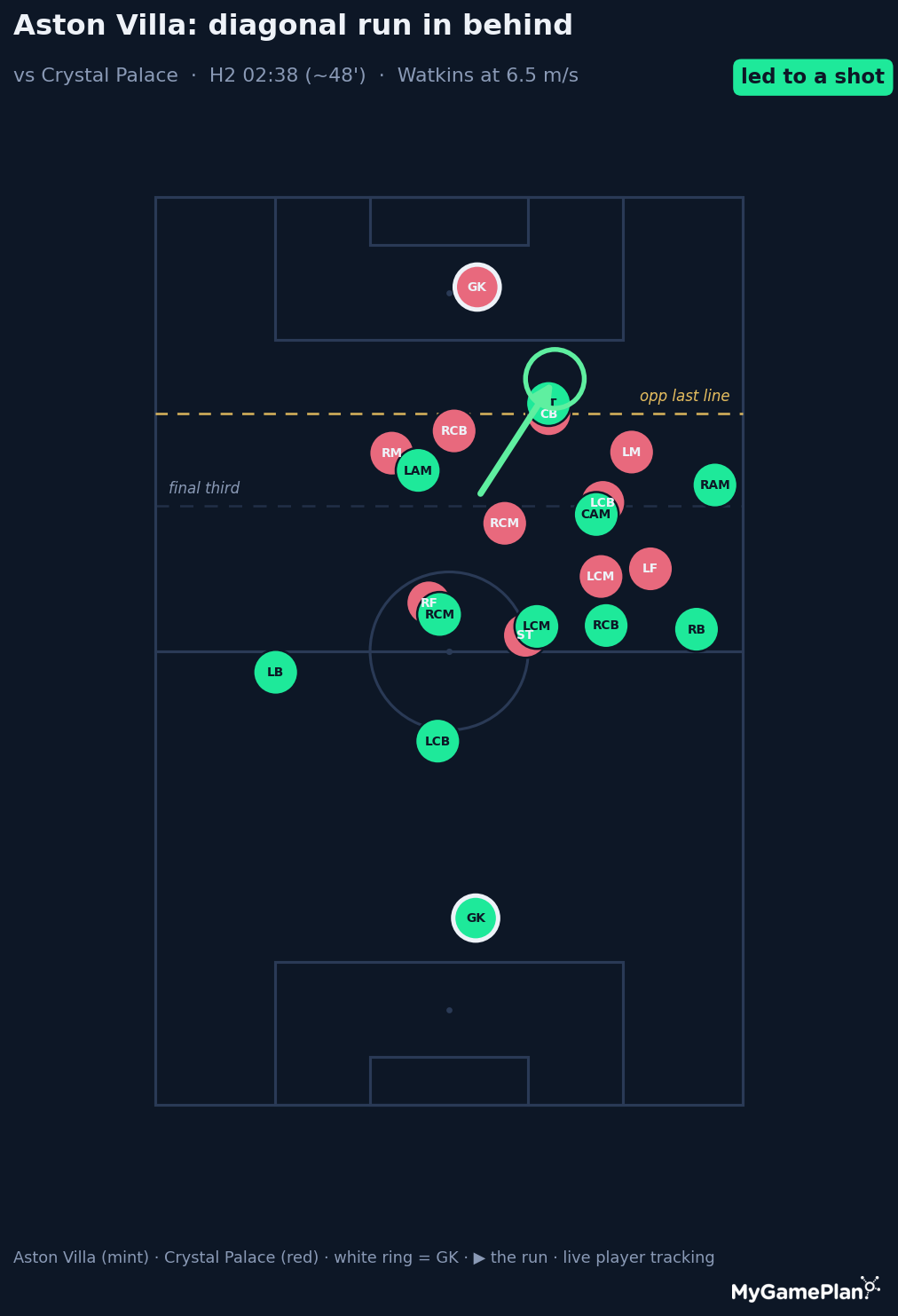
Below is a single example: Aston Villa's Ollie Watkins running in behind the Crystal Palace line into the right channel, taken straight from live tracking. The attacking team is in mint, the defenders in red, and the run is the bright arrow beating the last line before the shot.
How we measure it
The definition is deliberately relative to the defenders, not to fixed zones painted on the pitch. For every run we read where the opponent's back line actually is in that second, find the widest defender and the centre-back next to him, and check whether the run ends in that channel and in behind the last man. Because it reads the real back line, it adapts on its own: a back four, a back five with the wing-backs tucked in, or a back three are all judged correctly. The tracking underneath it is SkillCorner data.
The numbers hold up against FIFA's. Over the season, 112 goals came from a possession that contained one of these runs, about 0.29 a game, which sits just above the rate FIFA reported at the Under-17 World Cup. Nineteen percent of the runs led to a shot within twelve seconds, and around one in nine of all open-play shots in the league followed one.
How we built it, and why it changes the game
This did not begin as a data-science project with a brief and a two-week turnaround. It began as a question, asked in plain football language: which players get in behind, into the inside channel, and what happens next? That is exactly what MGPT, our AI football assistant, is built to answer. It reaches into the tracking and event data behind every match, works out what the question means, and comes back with the players, the numbers and the video. We layered the defender-relative logic on top for this piece, but the shift is the point.
For most of football's history this kind of analysis sat with a handful of clubs who could afford large data-science departments and the weeks of work each question demanded. That barrier is disappearing. With MGPT the distance between a tactical idea and the evidence for it collapses from weeks to minutes, in a coach's own language, on their own team, with the clips attached. That is what we believe changes football analytics for good: not another dashboard, but the ability for any coach at any club to interrogate the game as deeply as the richest teams in the world, and to watch it back in seconds.
The most effective attacking run in football is now something anyone can find, count and coach. This was one question. There are thousands more.
.jpg)