Blog·
The Modern Football Staff Room Is Full of Brilliant People Doing Brainless Work

MyGamePlan
Football Analytics Platform
And the clubs that fix that first will win. A long look at how the analyst, the coach and the club itself are about to change, and what we are building at MyGamePlan to meet it.
It is almost midnight on a Sunday somewhere in Europe, and one of the smartest people at a professional football club is doing the dumbest part of their job. The match finished hours ago. The stadium is empty, the staff have gone home, and an analyst is still at a screen, scrubbing through ninety minutes of footage a few seconds at a time, dropping a marker on every press, every transition, every set piece. It is meticulous, it takes most of the night, and by Tuesday it will be the raw material for an opponent file that someone else will spend another day turning into a presentation.
This person has spent years learning to read a game. They can tell you, instinctively, why a build-up keeps breaking down on the left or why an opponent is fragile in the ten minutes after they score. And here they are, at midnight, doing data entry. Not because anyone is cruel or short-sighted, but because that is simply how the work has always been done, and nobody has stopped to ask whether it still needs to be done that way.
I keep thinking about that midnight, because of what is happening everywhere else at exactly the same moment.
The rest of the economy already crossed this bridge
We are living through the largest shift in how knowledge work gets done since the spreadsheet. Companies most of us interact with every day, the Blocks and Amazons and Metas of the world, are restructuring whole departments around AI. Organisations with thousands of employees are quietly discovering that two people with the right tools now produce what ten people produced three years ago, and the change is not really about cutting headcount. It is about recognising that a large share of any knowledge job was never the point. The collecting, the formatting, the rebuilding of the same thing every week: that part is being handed to machines so the humans can go and do the part that actually needs a human.
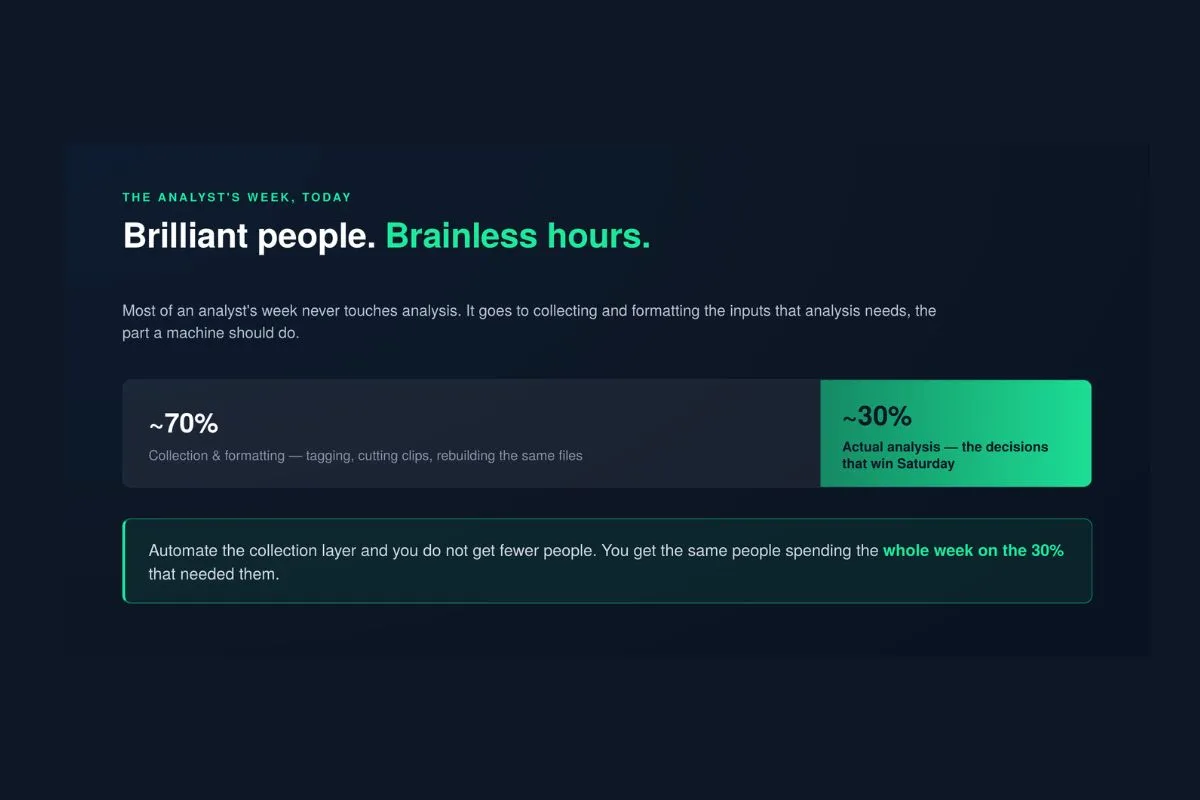
A lawyer does not become less valuable when software drafts the first version of a contract. They become more valuable, because the hours that used to disappear into drafting now go into judgement and strategy and the client in front of them. The dull seventy percent gets automated, and the irreplaceable thirty percent finally gets the attention it always deserved.
Football has the same seventy-thirty split. It has simply not acted on it yet. And the timing is what unsettles me. The season is ending for most clubs right now, budget meetings are happening behind closed doors, staff decisions are being made, and the job posts keep appearing in my feed with the same quiet message: additional analyst wanted, data analyst needed, one more person to handle the workload. You can read that as a sign of a maturing industry, clubs taking video and data seriously, professional standards rising across every division. In part that is exactly what it is. But step back and the picture is harder to love. Clubs are posting record losses. Wage bills are outrunning revenue. Owners give interviews about financial sustainability and spending smarter. And the standard answer to "we have too much manual work in the analysis department" is still, almost everywhere, to hire another human to do the manual work.
That is the irony I cannot get past. In the middle of the biggest automation wave in a generation, football is trying to solve a workload problem with payroll.
The job nobody questions
To see why this matters, it helps to look honestly at what an analyst's week actually contains, rather than what we imagine it contains. A large part of it is collection and preparation: tagging events, cutting clips, dropping them into slides, writing up the same structural notes on the next opponent that get written up every week. None of that is analysis. It is the manual labour that has to happen before analysis can even begin. The genuinely valuable part, the moment someone looks at the assembled picture and says "here is the weakness we can exploit on Saturday," often gets the smallest slice of the week, because everything that came before it ate the time.
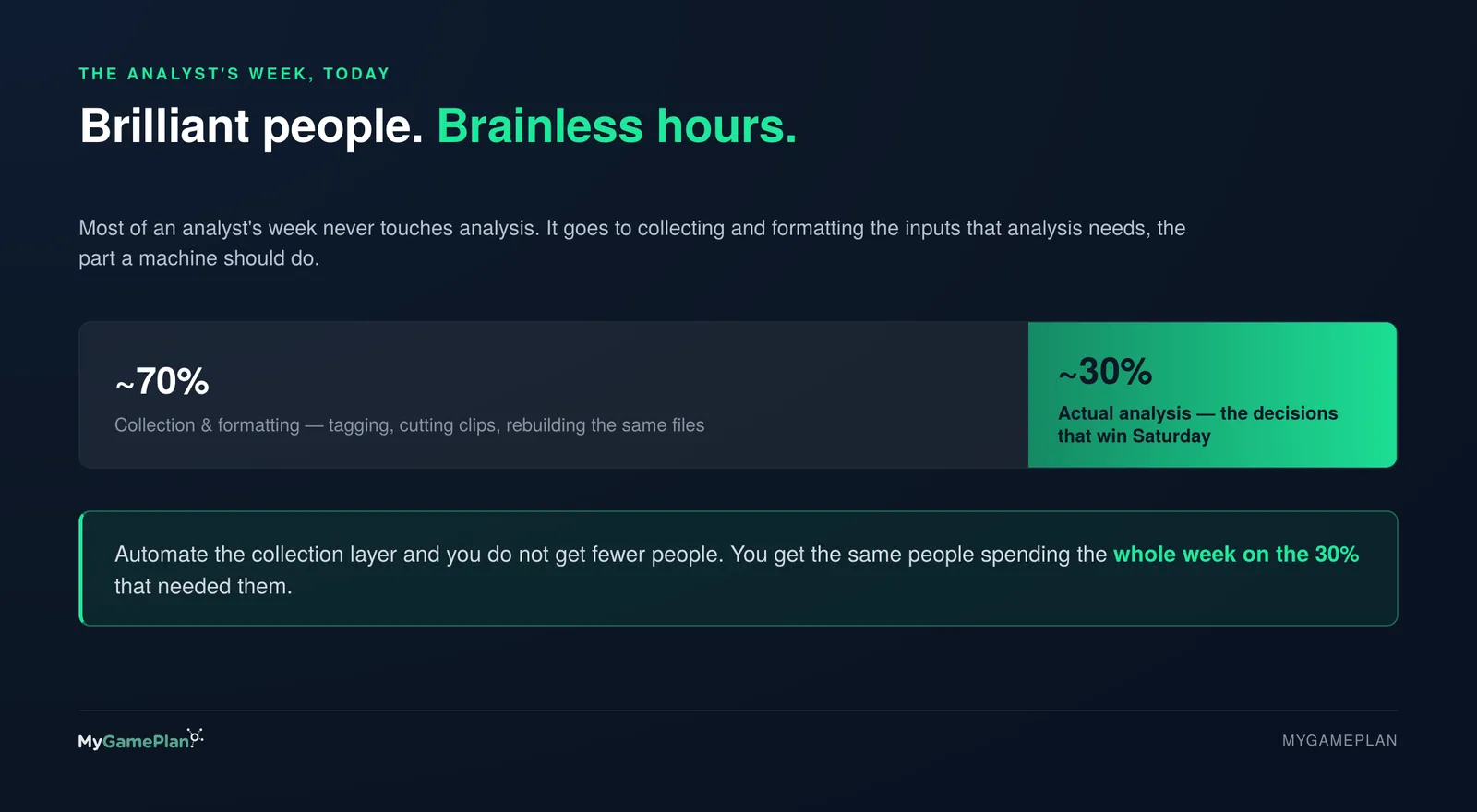
The modern football staff room is full of brilliant people doing brainless tasks. They are tagging the same patterns match after match, rebuilding the same report every Monday, manually assembling opponent files that are half out of date by kickoff. These are sharp, expensive, hard-to-replace people, and a meaningful portion of what they do does not require a human at all. I am not saying clubs should let any of them go, and I want to be clear about that because it is the first place minds tend to jump. I am saying the people clubs already employ should be spending their hours on work that genuinely needs a brain, and that the clubs who arrange things that way first will hold a real advantage. Not because they spent more, but because they stopped wasting the intelligence they already pay for.
The more expensive mistake, in a smarter suit
There is a second version of the hiring reflex, and it usually looks like the responsible, forward-thinking choice. It is the club that decides not to hire another analyst but to be modern about the problem instead: hire a data scientist, build an internal platform, own the stack, do it properly. A year on, that ambition has often become a half-finished dashboard that breaks every time a data provider changes a feed, that lives almost entirely inside one person's head, that nobody else can maintain. And when that person takes a better-paid role elsewhere, which in this market they reliably do, the whole thing leaves with them and the club starts again from nothing.
Both roads arrive at the same destination: real money spent to keep doing manual work, just with more steps and a longer invoice. The lesson is not "never hire" or "never build." It is that throwing bodies, or salaries, at a workload problem is the old answer to a question that finally has a new one. The clubs that are starting to pull ahead are asking something different. Not "who can we hire to do this," but "why is a person doing this at all."
The job is changing, and most people in it are not ready
For anyone who actually works inside a club, this is the part that matters, because the roles are not vanishing. They are changing shape, and quickly, and the distance between the people who see it coming and the people who do not is about to widen in a way that will be hard to close later.
Start with the analyst. I want to be careful here, because manual tagging built this industry and the people who do it are genuinely skilled, but tagging is becoming the horse and cart. The value was never in the tagging; it was always in the question the tagging was meant to answer. The analysts who win the next two seasons will be the ones who stop being a data-entry layer and become the person in the building who asks the sharpest questions of the data and reaches an answer first. The tool does the collecting. The human does the thinking. That is the only division of labour that will make sense, and it is a better job than the one most analysts have today.
The coach's role shifts in parallel. Within two or three seasons, the strongest coaches will work the way the strongest founders already do, surrounded by assistants that never tire and never run out of time before Saturday. One prepares the opponent. One pulls every clip matching a specific situation across the last ten matches in seconds. One drafts the training session and explains the reasoning behind every part of it. The coach still decides everything, still leads the room, still reads the players, still owns the call. But a coach who refuses to delegate to those assistants will be out-prepared every single week by one who does, on the same budget, with the same staff, in a fraction of the time. The same logic is about to reach the touchline itself, where live, in-game support will move from novelty to expectation. Most in-game decisions today are made on instinct, a laminated sheet and whatever the bench can hold in its head; over the next two seasons, support that tells a staff what is actually happening on the pitch, rather than what they hope is happening, will become normal, and the clubs comfortable with it early will build an edge that compounds match after match.
The most interesting shift, though, is that all of this gets personal. The AI inside a club is going to become deeply individualised. It will learn the head coach's principles and the way this particular staff likes to see information. It will know each player's pathway, where they came from, what they have already been coached on, which working points are still open, what they respond to and what they shut down at. And that carries a quieter benefit almost nobody is pricing in. Today, when a coach or an analyst leaves, the club loses their knowledge; it walks out of the door with them every time, and the next person rebuilds that understanding from scratch. An AI trained on the context of the club keeps that memory inside the building. For the first time, institutional knowledge stops being something a club bleeds with every staff change and starts being something it accumulates.
What this actually looks like, week to week
All of this stays abstract until you put it on a calendar, so let me walk through a single week at a club that already works this way. Not in five years. With what is buildable today.
By Tuesday, the next opponent is in focus, and instead of an analyst spending a day and a half building the file, the picture is already waiting. The opponent's strengths and weaknesses are surfaced automatically, each one written as a short, readable insight rather than a wall of numbers: they concede most of their chances from the left half-space, they are vulnerable in the ten minutes after conceding, they commit numbers forward on attacking corners. The part that changes everything is that none of it is generic. The opponent's profile is framed against your team specifically, so the platform does not merely list what they do well; it shows where their weaknesses meet your strengths and where your weaknesses meet theirs. And every claim sits one click from the video that proves it. The analyst is no longer hunting for footage to support a point. The point arrives with the footage already attached, and the analyst's Tuesday becomes reading it, challenging it, adding the human judgement a machine cannot, and walking into the coaches' meeting with a plan rather than a pile of clips.
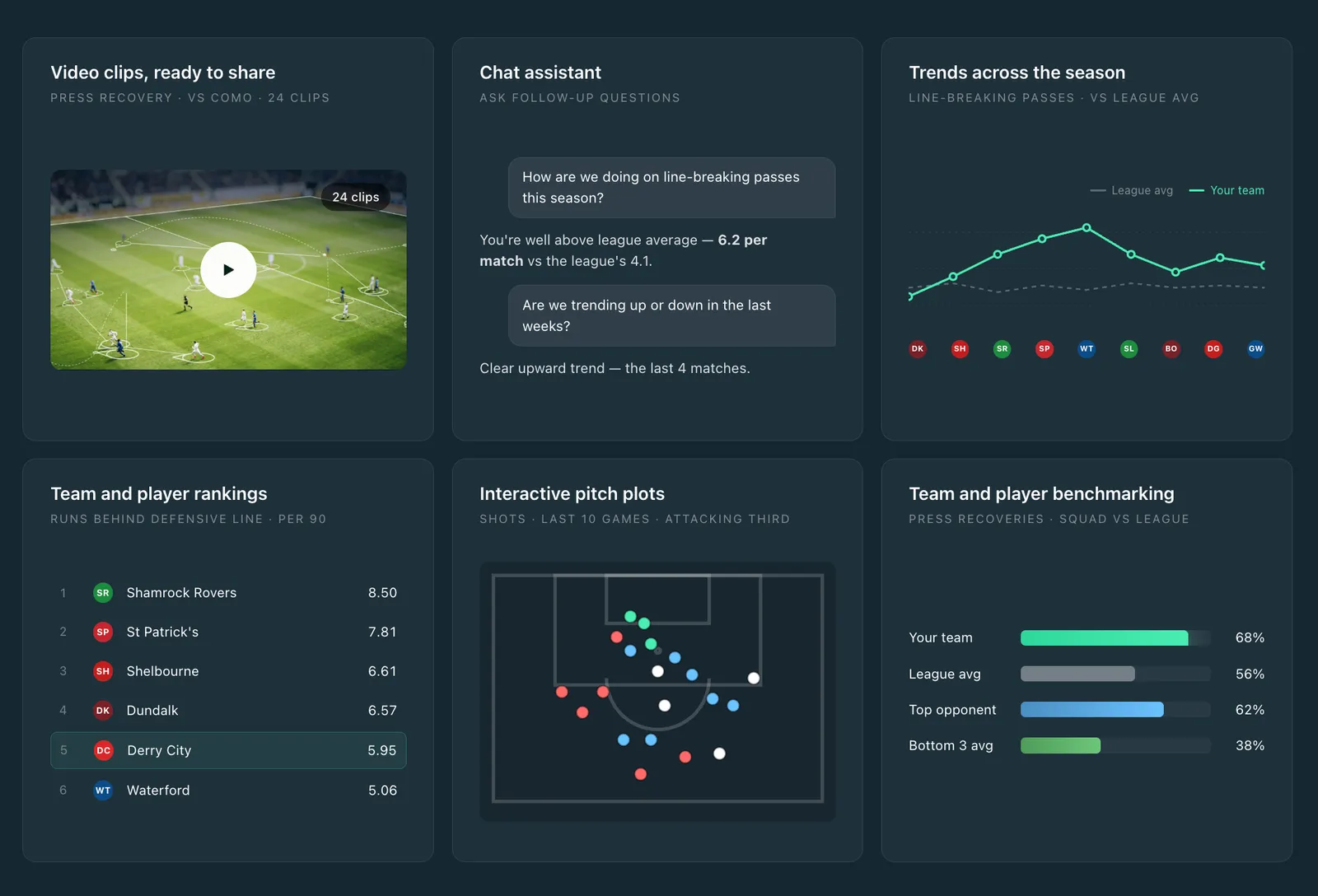
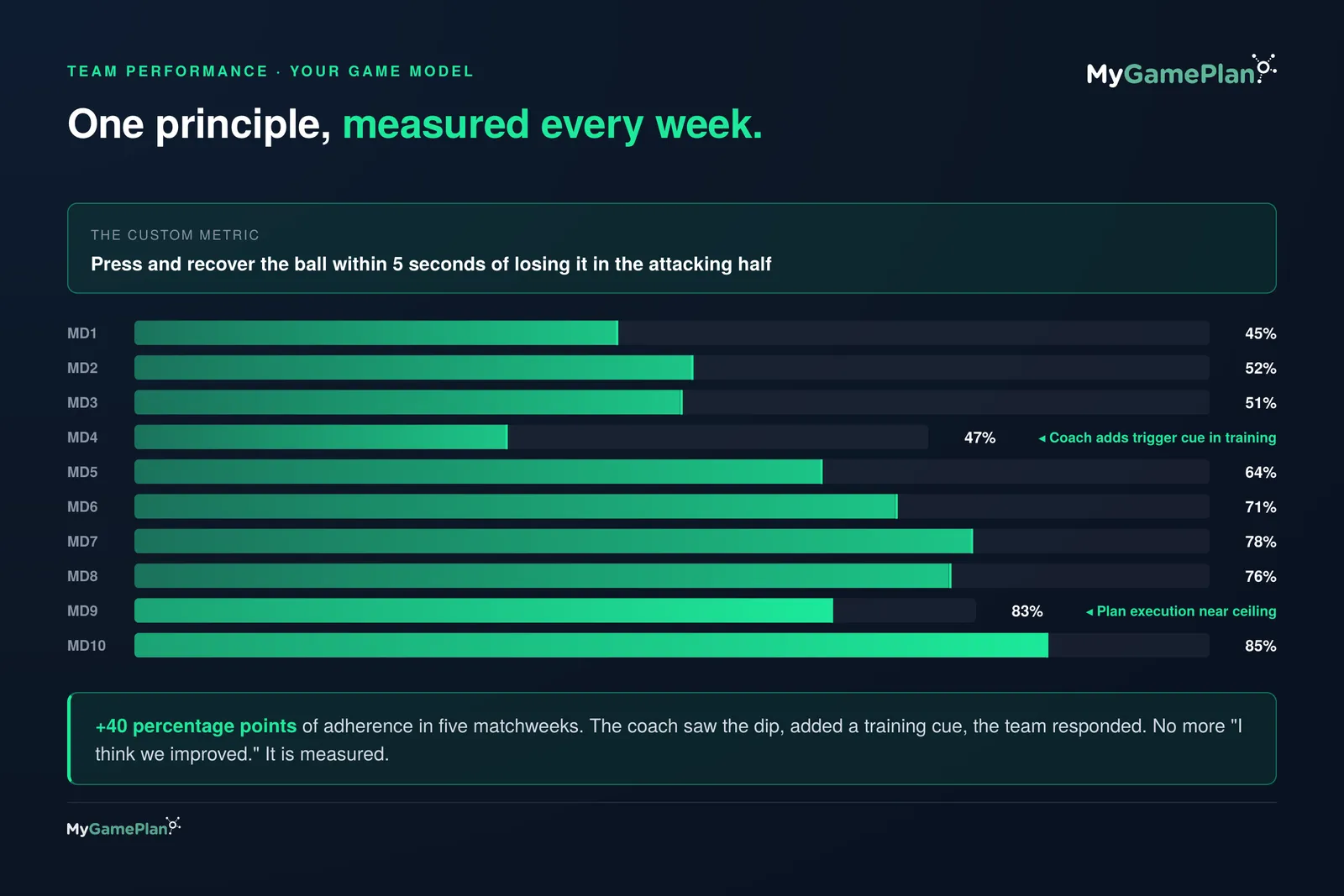
The Monday after a match changes just as much. The review is no longer an argument about what people think they saw. The coach receives detailed, tailored feedback on the decisions actually made on the pitch, each one tied directly to the video moment. Not a vague "we lost the ball too often in midfield," but the specific sequences and the specific choices, scored against how this team is meant to play and against its own history rather than a flat league average: the decision to step out and press here, the decision to stay compact there, the build-up pattern that worked in the first half and quietly disappeared in the second. Each is surfaced, each is clickable, each is ready to show the player or the group. The conversation in the room transforms when it is anchored to evidence instead of memory, and the coach spends the meeting coaching rather than searching for the clip that makes the point. And because the same principle is measured every week, a coaching idea stops being a hunch and becomes a line on a chart that the whole staff can watch move.
Through the rest of the week, development stops being a privilege reserved for the two or three loudest cases. Every player in the squad is scored against the club's philosophy, against the specific profile of how this club wants that role to be played, not against some neutral idea of "good." From those scores, individual development pathways draft themselves out of each player's actual weaknesses, with concrete working points and clips attached, and they flow straight to the player's phone through the companion app. The nineteen-year-old gets a clear, personal picture of the two things to work on this month and exactly what good looks like, with examples; the senior pro gets the same; and the coach reviews and adjusts rather than building each plan by hand from nothing. This is the difference between a club that develops its best handful of talents and a club that develops its whole squad, and the bottleneck was never the will to do it. It was always the hours.
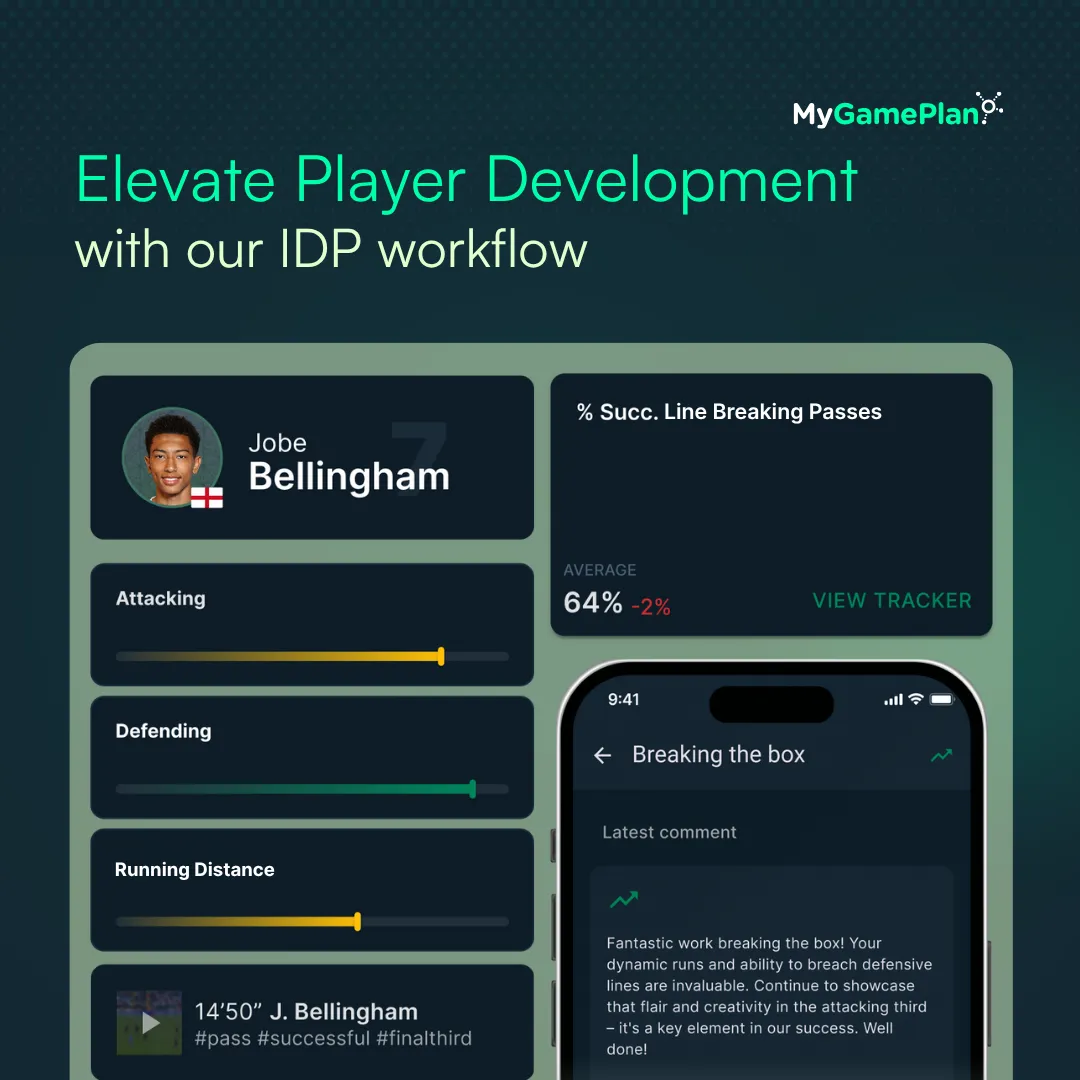
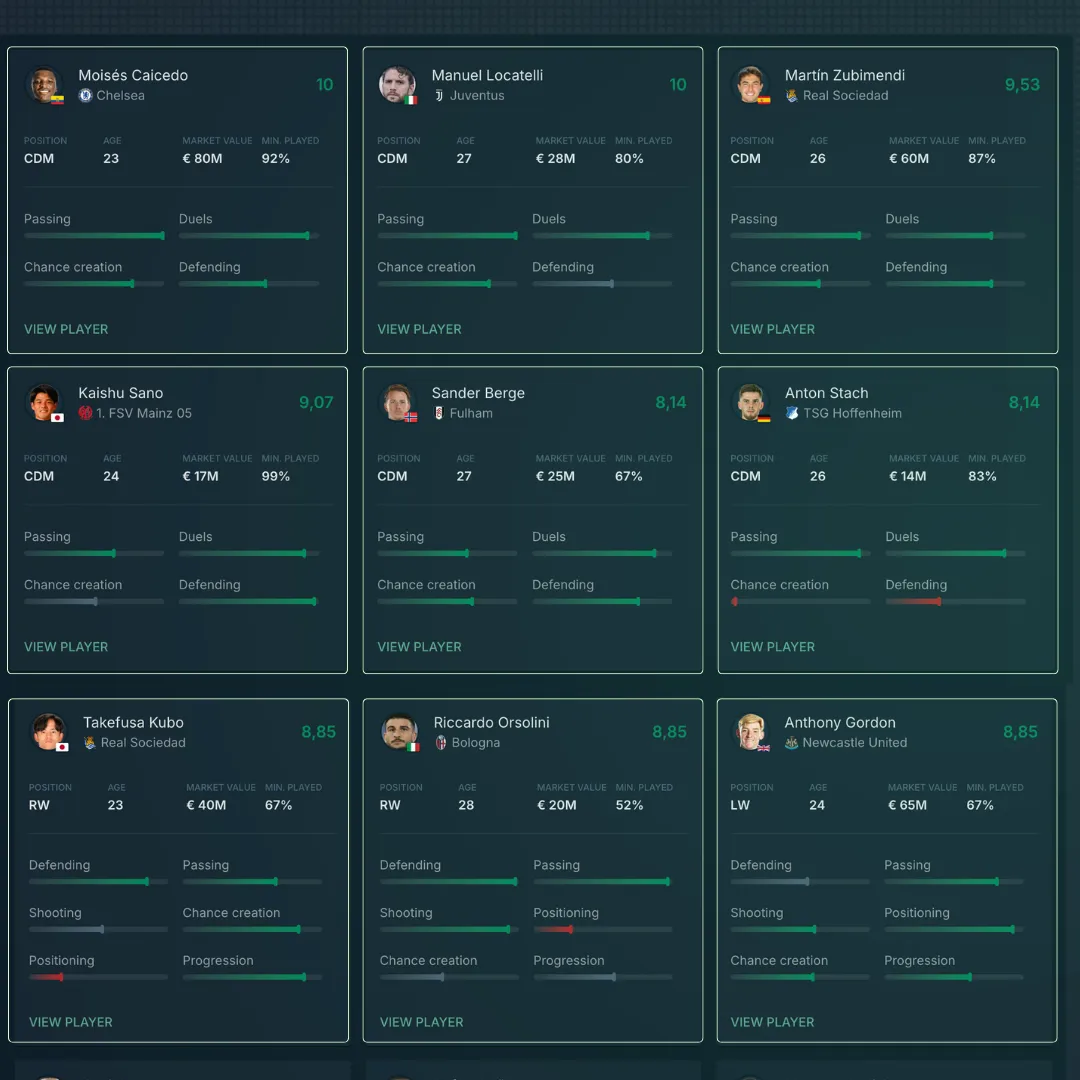
And when a gap opens, because a player is leaving or a weakness in the squad has become undeniable, it does not sit there while the recruitment department begins a months-long search from a blank page. The profile of what is needed, the exact role, the style, the physical and tactical requirements, is already understood, because the system already understands the team. The shortlist fills with players who match that profile across the leagues the club covers, scored on the very same metrics the club uses to judge its own players, with market data alongside and the video right there. Recruitment becomes a continuation of how the club already thinks about football rather than a separate world speaking a different language. None of these four moments is science fiction; they are the four things clubs already spend their week on. The only thing that changes is who does the manual part of each.
But what about the people
This is the honest objection, and it deserves an honest answer rather than a dodge. None of this is an argument for smaller staffs or for quietly replacing the humans who make a club run; it is the opposite, and I would not be building any of it if I believed otherwise. The work that genuinely needs a person, reading a room, knowing when to push a player and when to leave them alone, holding relationships together, making the call under pressure with a season on the line, is going nowhere. It was always the work that mattered. The trouble is that today it sits buried under hours of tagging and exporting and formatting and rebuilding the same files, and if you lift that layer away you do not end up with fewer people. You end up with the same people finally doing the job you hired them to do. The clubs that understand this will not strip their analysis departments to the bone. They will out-think clubs twice their size, because every brain in the building will be pointed at something worth thinking about instead of something a machine should have finished overnight.
Where MyGamePlan is right now
I would not write any of this if we were not living it ourselves, and the last couple of seasons have taught us how fast a club's appetite for this can grow.
MyGamePlan started as a Belgian idea and a team of eight. Today it runs at more than forty professional clubs across roughly seventeen countries and four continents. What I find most telling is not the headline number but the shape of the growth. In some markets we are going deep: in Sweden we work with Malmö FF, Mjällby AIF, IFK Göteborg and Varbergs BoIS; in the Netherlands with NEC Nijmegen, FC Volendam, VVV-Venlo and FC Eindhoven. In others we are planting flags in new territory: Como in Serie A, QPR in the Championship, Genk and RAAL in Belgium, St. Gallen in Switzerland, CF Montréal in MLS, Al-Taawoun in the Saudi Pro League, and most recently Independiente del Valle in Ecuador, our first club in South America.
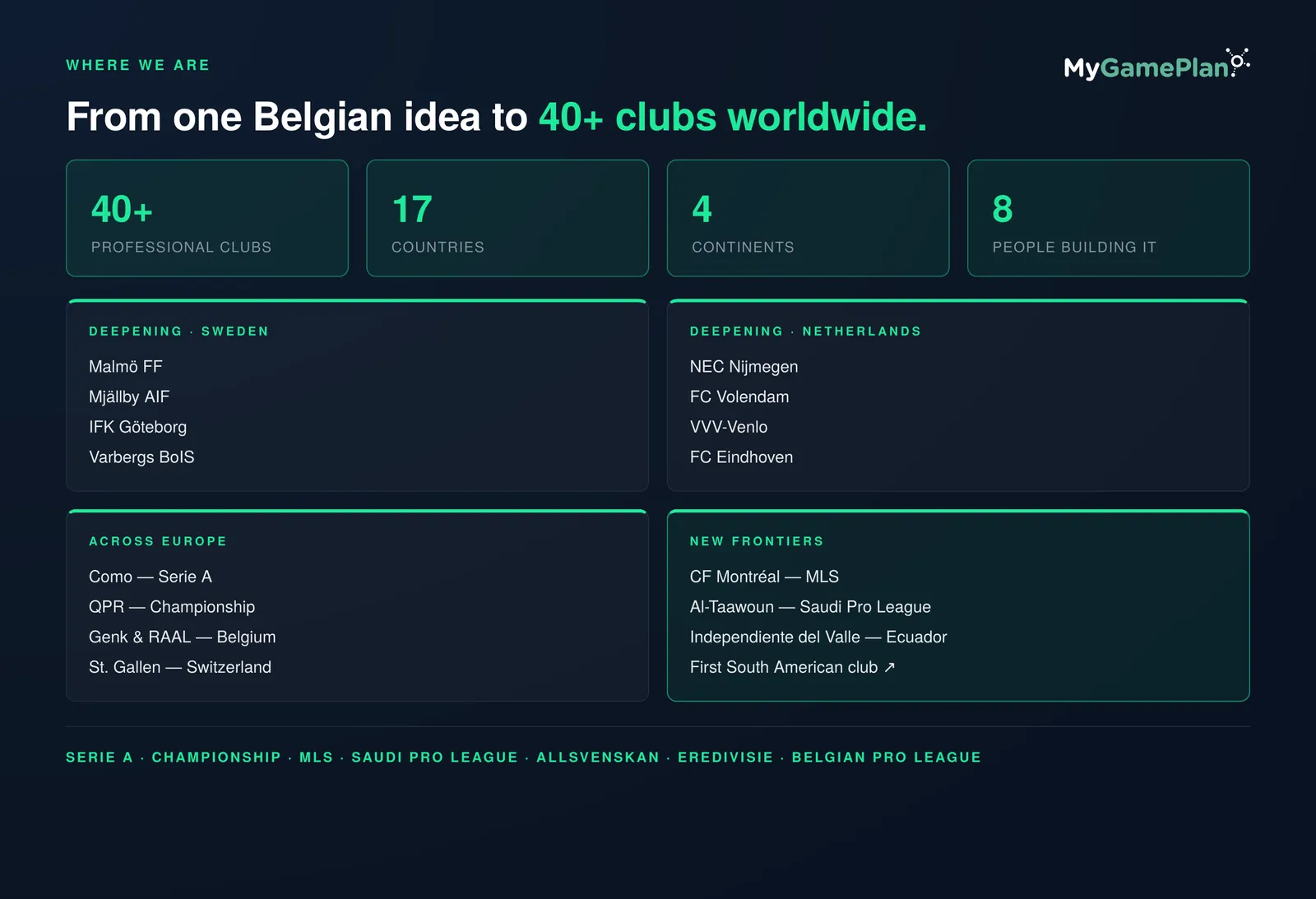
Same small team. A footprint that keeps widening. Which is, once again, the whole point of this essay: with the right tools, a small group goes a very long way.
Everything we build rests on a single idea. Any tactical thought a coach has, passes into the final third under pressure, high-press recoveries within five seconds, goalkeeper distribution into the wide channels, should become a custom, video-backed metric without anyone tagging a thing. We call it a Performance Tracker, and it is the building block beneath every module I have described: own-team review, player development, opponent analysis and recruitment all run on the same foundation. Two parts of how we deliver that are worth drawing out, because they are the clearest embodiment of everything argued above.
MGPT: a football expert sitting next to you
The first is the assistant at the centre of the platform, a football expert on tap with access to all the data and video a club already has. You ask it a question the way you would ask a trusted colleague, show me their high-press recoveries over the last five matches, or build me a tracker for crosses from the half-space, and rather than handing back a spreadsheet to decode it returns the trackers, the clips and the graphs that answer the question. Because it is built on the context of your club and your coach, the answer comes back in your language rather than a generic one, and because it is linked to video, every claim it makes sits one click from the proof on the pitch.
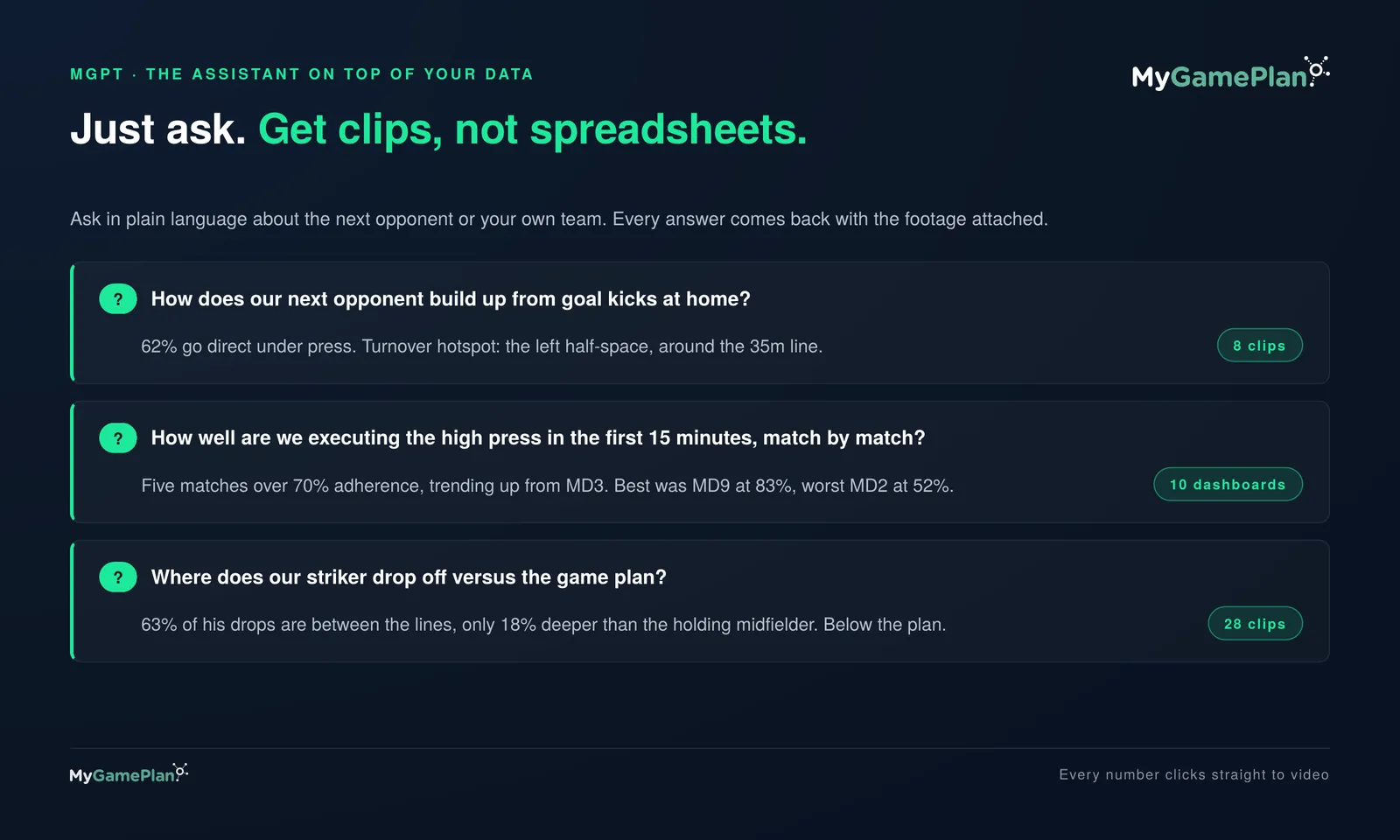
That is the difference between having data and having an analyst's brain available the moment you need it, and we are betting the whole product on that difference.
→ Start with MGPT: open the homepage and start typing a question, the way you would ask a member of your staff.
XML and tagging automation: hand the manual work to the machine
The second is the most literal version of this entire argument. In most clubs an analyst still tags a match by hand, every pressing trigger and transition and set piece, hours of it, every week, producing output of the same shape every time. It is the purest example of a brilliant person doing brainless work, so we automated it: the AI does the pattern detection and produces the XML your existing video tools already understand, which turns the analyst from the collection layer into the editor, checking and refining and spending the hours they just recovered on the part of the job that needed them in the first place. It is the clearest "two people doing what ten did" moment we have, and it is live today.
Proof, not promises
It is easy to write an essay like this and sound like a futurist, so here is a club doing it in the real world rather than in two seasons' time. Queens Park Rangers use MyGamePlan as part of how they prepare and review, and the story lands far better in their words than in mine. If you want the honest answer to whether this holds up inside a real club, on a real schedule, under real pressure, that is where to find it.
Football is about to split into two kinds of clubs
Not big and small, and not rich and poor; those divides have always existed and always will. The new split is between clubs that let their people think and clubs that keep their people tagging. One group will treat AI the way the best companies outside our industry already do, as a way to lift the manual work off brilliant people and aim them at the problems only humans can solve. The other will keep posting the same vacancy, keep hiring its way around the problem, keep adding to a wage bill it already complains about, and keep wondering why a club with half the budget keeps turning up better prepared.
I know which side I want to be on, and we built MyGamePlan for the clubs that want to be on it too. If you would rather feel the difference than read about it, the simplest way is still the best one.
→ Open MyGamePlan and ask it a question
Run this on your own matches.
Ask MGPT about your team or your next opponent. Free to try with your professional email.