Opponent analysisTeam reportSeason reportTactical concept

Read every goal kick they take.

Every goal kick they take, sorted: how often they go long or play out, where the short build goes first, what each route produces, and what it costs them when it goes wrong.

Watch the full report ↗

Opens the real report on open data: Club Brugge, Belgian Pro League 2021/22. No account needed.

The prompt behind it

Show how Club Brugge play out from their own goal kicks, and where each route gets them.

Change a word and you get a different report. Same template, your question.

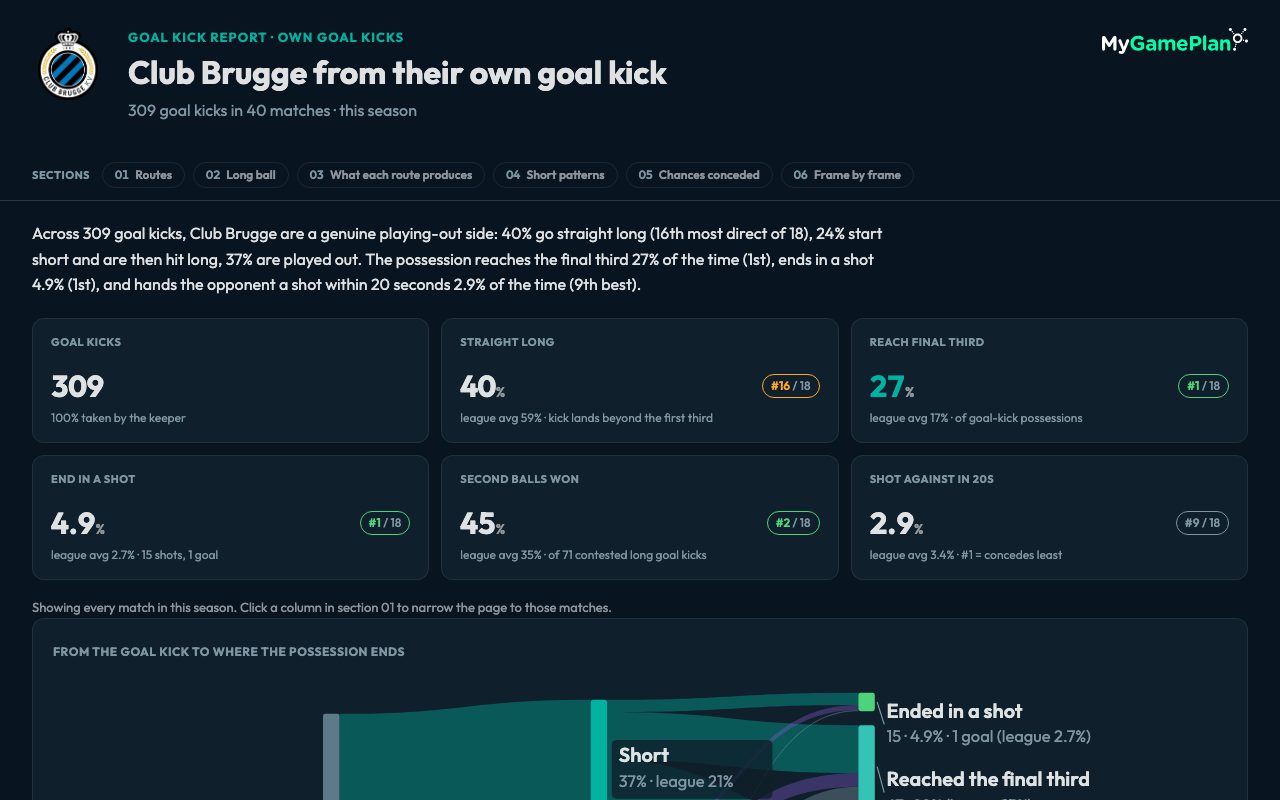
app.mygameplan.ai/try/goal-kicksOpen ↗Goal kicks, the first screen of the real report on Club Brugge

The report, section by section

Six sections, the way this template is written today.

Scroll down. Every number here is the real report's, on Club Brugge 2021/22, and the report itself is one click away, behind Watch the full report. Keep these six, cut the ones you never read, or prompt for another.

01

Route, match by match

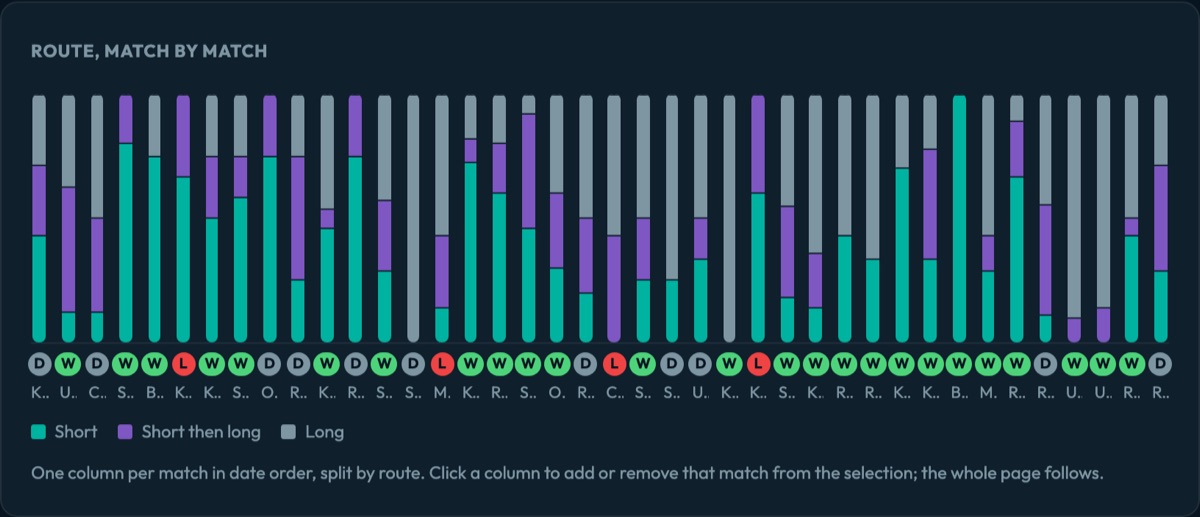
One column per match in date order, split by route

Stacked column per Club Brugge match in 2021/22, splitting each match's goal kicks into short, short then long, and long, with the result under each column

01 · The routes

Club Brugge play out. The opponent decides how often.

Across 309 goal kicks, Club Brugge go straight long 40% of the time, the 16th most direct side of 18. Another 24% start short and are then hit long, and 37% are played out. S. Mignolet takes 97% of them.

The column per match is where the story starts: the long share runs from 0% against SV Zulte Waregem to 100% against KV Kortrijk, while the score barely moves it. So the question for Saturday is not what Brugge do, but what this opponent makes them do.

02

First ball, second ball

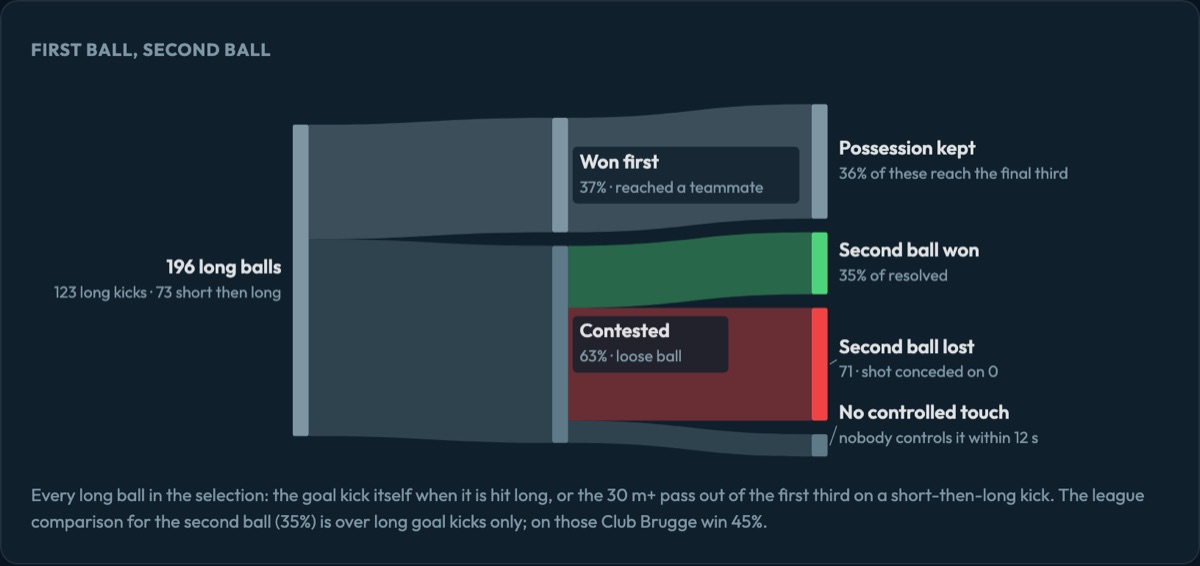
Every long ball: the long goal kick, or the 30 m+ pass out of a short start

Flow of Club Brugge's 196 long balls from goal kicks: won first, contested, second ball won, second ball lost, no controlled touch

02 · The long ball

When they go long, they go looking for the second ball.

A long goal kick from Club Brugge reaches a teammate 34% of the time, against a league 22%, and it is aimed left 39% of the time, most often to N. Lang. On long goal kicks the second ball comes back to them 45% of the time, 2nd of 18.

That changes the plan without the ball. Pressing the short build is only half the job: once the ball is won back, 33% of those possessions reach the final third, so the midfield has to be set for the knock-down as much as for the kick.

03

What each route produces

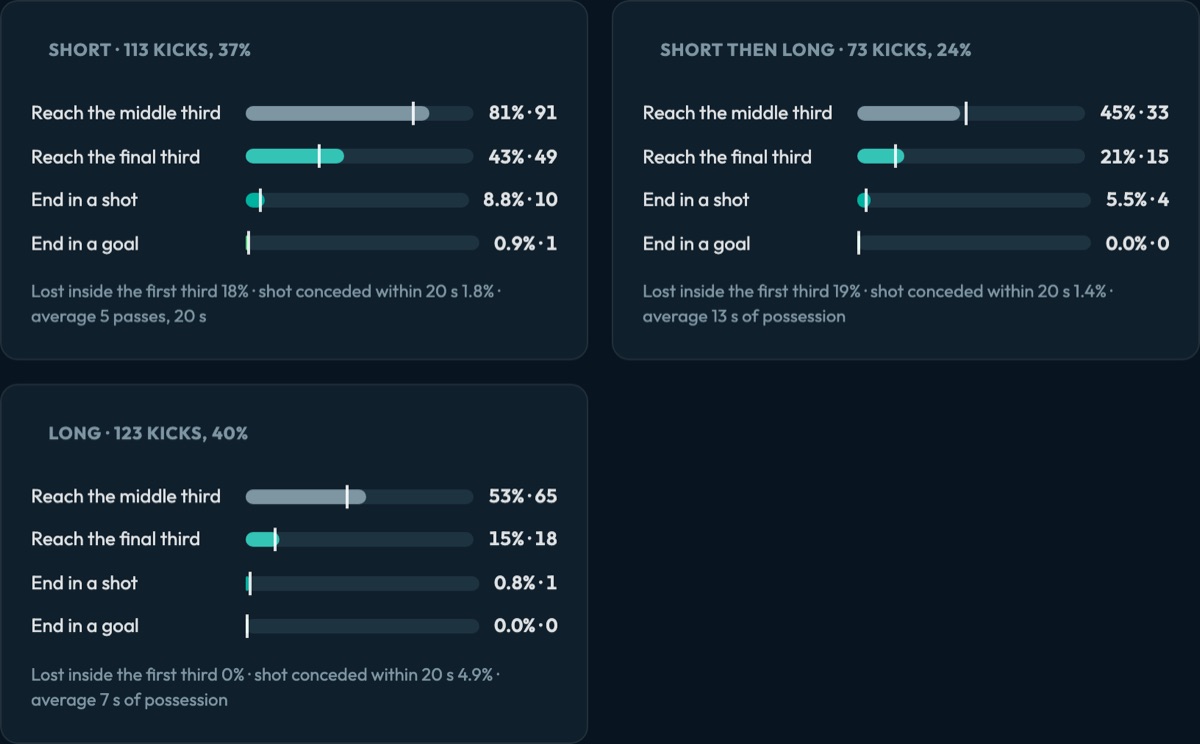
Outcome of each route's possession, with the league figure as a tick

Bars for Club Brugge's short, short then long and long goal kicks: share reaching the middle third, final third, a shot and a goal, with the league figure marked

03 · What each route produces

The short route is the one that hurts.

Each route is followed until the opponent has the ball. Played short, 43% of Club Brugge's possessions reach the final third (league 31%) and 8.8% end in a shot (league 5.9%). Straight long, it is 15% and 0.8%.

Overall their goal kicks reach the final third 27% of the time and end in a shot 4.9%, both 1st in the league. Forcing this side long is not a concession, it is the aim.

04

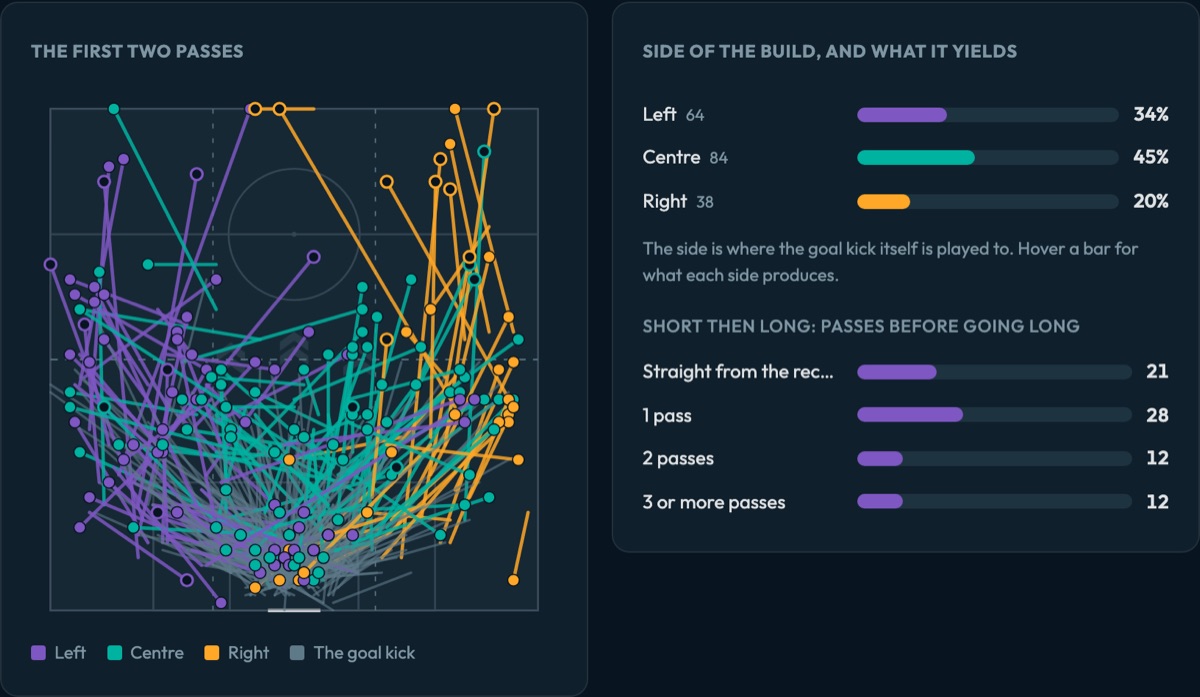
The first two passes

Every short-origin goal kick, coloured by the side it is played to

Pitch with the first two passes of every Club Brugge short goal kick, coloured left, centre and right, beside the share of builds down each side

04 · The short build

Through the centre, to Mechele, most weeks.

On 186 short-origin goal kicks the build goes down the centre 45% of the time, left 34% and right 20%. The first pass finds B. Mechele 34% of the time, then S. Nsoki 22%.

The centre was the dominant side in 13 of the 25 matches with at least four short-origin kicks, so it is a habit rather than a plan for one opponent. That gives your press a trigger to rehearse all week.

05

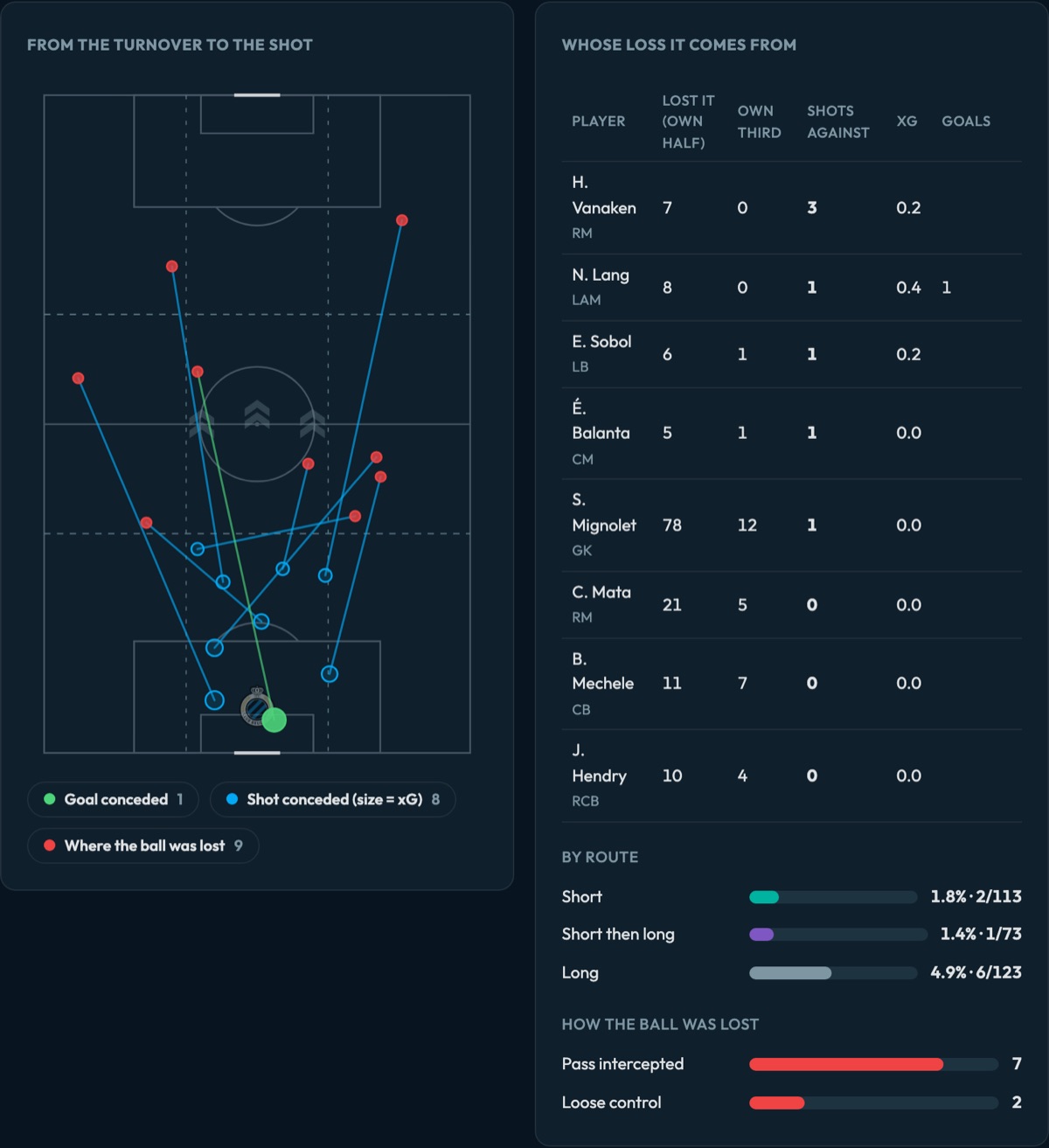
From the turnover to the shot

Opponent shots within 20 seconds of a Club Brugge goal kick

Pitch linking each Club Brugge turnover after a goal kick to the opponent shot that followed, beside a table of whose loss each came from

05 · Chances conceded

Where playing out costs them, and it is rarely.

9 of 309 goal kicks end with the opponent shooting within 20 seconds, 2.9% against a league 3.4%: 0.9 xG and 1 goal conceded, 9th best of 18. The riskiest route is long, 6 shots against from 123 kicks.

The table says whose loss it is: 3 of the 9 shots follow a turnover by H. Vanaken, and 7 of the 9 losses are an intercepted pass. That is the player and the moment to press.

06

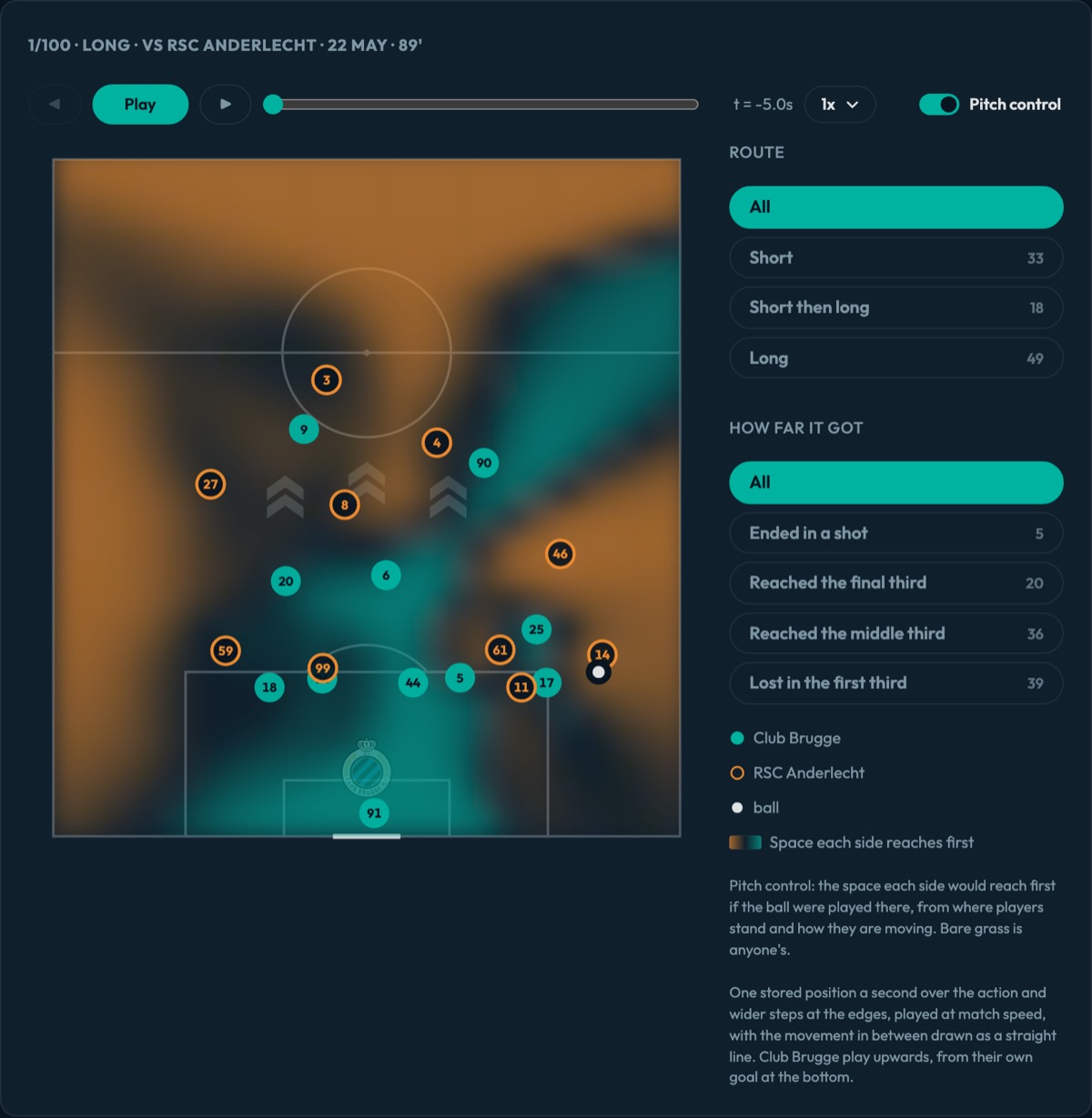
The goal kicks, frame by frame

Tracking playback with pitch control, 100 most recent goal kicks

Tracking playback of a Club Brugge long goal kick against RSC Anderlecht, with pitch control shading and filters by route and outcome

06 · Frame by frame

The 100 most recent goal kicks, not the best ones.

The last section plays the 100 most recent goal kicks with tracking, from the ball on the spot to ten seconds after the possession ends, with pitch control showing the space each side reaches first. This one is a long kick against RSC Anderlecht on 22 May, in the 89th minute.

Filter by route or by how far it got, and the numbers above turn back into shapes. Your staff sees how the press was set up, not just how often it worked.

Next to this one

Opponent analysisTeam reportSeason report

Full opponent report

Context and form, a phase-by-phase read of their game ranked against the league, then the players who decide it. The pack your analysts build by hand today.

Build the full opponent report for our next opponent, last six matches.

See the template →
Opponent analysisTeam reportSeason report

Pressing report

Tactical concept

Pressing in open play and on goal kicks: the triggers, the real shape from tracking data, and the games where the press got broken most.

How aggressive do they press against short build-up?

See the template →
Opponent analysisTeam reportSeason report

Build-up in open play

Tactical concept

Build-up shapes from tracking data, the routes out, and where the ball is actually lost.

Break down their build-up shapes and where they lose the ball.

See the template →

All templates →

Same report, your club's data.

Create an account on the live platform and run this template on your own club.

Try for free